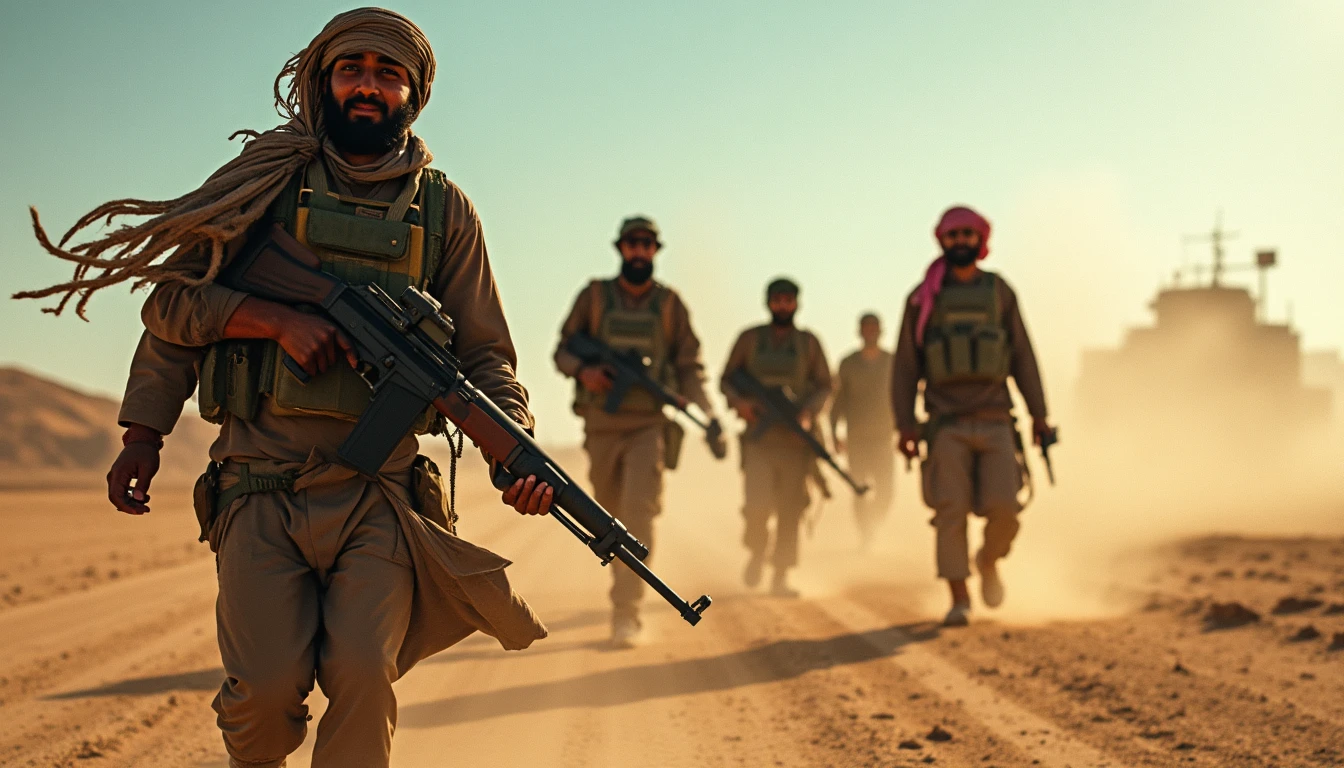
Houthis Take Mocha and the Full Yemeni Shore of Bab al-Mandab: What Is Actually Confirmed
Multi-perspective analysis. Each perspective deliberately argues one viewpoint; none represents the editorial position of qalarc.
Fighters from Yemen's Houthi movement (Ansar Allah) have seized the Red Sea port city of Mocha and taken control of Yemen's entire coastline along the Bab al-Mandab Strait, the chokepoint linking the Suez Canal to the Indian Ocean [3]. Reporting by Reuters, citing sources, says Iranian military advice and arms assistance were critical to the offensive [2]. The advance — the movement's most significant conventional territorial gain in years — has unsettled oil and freight markets already strained by two years of Houthi attacks on commercial shipping.
The facts (8)
- In early September 2026, Houthi (Ansar Allah) forces captured Mocha in Taiz governorate and consolidated control of the Yemeni shore of the Bab al-Mandab Strait, giving the movement a hold on the full Yemeni side of the waterway; the western shore remains Djiboutian and Eritrean territory [3][1].
- Reuters, citing sources, reported on September 10, 2026 that Iranian arms advice helped the Houthis seize the key Red Sea city — an account placing Tehran's advisory and matériel role at the center of the offensive [2].
- The coastal offensive follows the 2026 Iran war between Iran and the Israeli–American side, and a June 2026 ceasefire that has repeatedly faltered: CNN reported Israel and Iran trading their heaviest strikes in months on June 7–8, 2026 [4][6].
- Mocha had been held by the internationally recognized Yemeni government and its Saudi-led coalition backers since coalition-aligned forces retook it from the Houthis in 2017; its fall reverses one of the coalition's few durable coastal gains of the past decade. (No independent citation available in the verified set.)
- Gulf News reported that a Saudi oil pipeline may be hit as Houthi attacks escalate; the report remains unconfirmed, and neither Riyadh nor state oil infrastructure authorities have verified any strike on Saudi energy assets.
- Vessel-tracking services show merchant transits through the southern Red Sea and Bab al-Mandab still running at a fraction of pre-2023 volumes after Houthi attacks forced carriers onto the Cape of Good Hope route; Houthi control of Mocha and the strait coast extends leverage over the traffic that remains [7].
- Energy analysts and market participants warn that Houthi control of the strait's Yemeni shore will raise war-risk insurance premiums and freight costs and could lift diesel and refined-product prices in Europe; extreme projections circulating among retail traders — a full closure driving crude toward $500 a barrel and a European winter energy emergency — far exceed mainstream analyst scenarios.
- Analysts note the Houthis already administer roughly 70–80 percent of Yemen's population, hold the capital Sanaa and the main Red Sea port of Hodeidah, and have outlasted since 2015 a far better-funded Saudi-led coalition equipped with F-15s and Abrams tanks — factors cited to explain the movement's battlefield resilience.
Context & background
Ansar Allah, widely known as the Houthis, seized Yemen's capital Sanaa in 2014, prompting a Saudi-led coalition intervention in March 2015. Despite overwhelming air power and Western-supplied equipment, the coalition failed to dislodge the movement; a UN-brokered truce has held fitfully since 2022 while the group consolidated political and military power under its leader, Abdul-Malik al-Houthi, retaining missile and drone capabilities widely attributed to Iranian supply. From November 2023 the Houthis attacked commercial shipping in the Red Sea and Gulf of Aden in solidarity with Gaza, triggering US and British strikes and forcing most carriers to reroute around southern Africa; Israel's Port of Eilat declared insolvency in 2024 as its traffic collapsed. The September 2026 coastal offensive lands within the wider framework of the 2026 Iran war and its fraying ceasefire arrangements [4][5], and the Associated Press has reported the Mocha operation as part of a broader escalation spanning Gaza, Israel, Lebanon, Yemen and Iran [1].
Still unresolved
- Will Saudi Arabia or the United States respond militarily to the collapse of the government-held Red Sea coast, and is the reported threat to a Saudi oil pipeline confirmed?
- Does Houthi control of the strait's Yemeni shoreline amount to a functional ability to close Bab al-Mandab to navigation, or does it largely formalize disruption already priced in by rerouted carriers and insurers?
- How extensive was the Iranian advisory and arms role described by Reuters — and does it test the limits of the June 2026 ceasefire framework?
Quick answers
What happened?
Fighters from Yemen's Houthi movement (Ansar Allah) have seized the Red Sea port city of Mocha and taken control of Yemen's entire coastline along the Bab al-Mandab Strait, the chokepoint linking the Suez Canal to the Indian Ocean [3].
What's the evidence?
Checked against 14 candidate sources; the strongest references include: AP News — Mideast coverage: Houthi seizure of Red Sea coast amid the Gaza–Israel–Lebanon–Iran escalation; Reuters (Sept 10, 2026) — Iranian arms advice helped Yemen's Houthis seize key Red Sea city, sources say; Reuters World/Middle East — reporting on the Houthi capture of Mocha and the Bab al-Mandab coast.
Who benefits?
Iran (IRGC-Quds Force and Tehran's political leadership) — A second global chokepoint veto alongside Hormuz, acquired by proxy at near-zero attribution cost. Listed tanker and container owners (Frontline, Hafnia, Torm, Scorpio Tankers; Maersk, CMA CGM, Hapag-Lloyd) — Windfall freight earnings.
How confident is the assessment?
The motive analysis is 70% confident.
Why does it matter?
War-risk premium ticks up -> carriers reroute via the Cape -> fleet capacity absorbed -> spot freight triples -> European import costs rise -> goods inflation slows ECB easing -> OECD consumers unknowingly subsidize a militia's targeting calculus.
The same story, argued three ways. Pick an angle — the facts above stay the same.
🧭 Cui bono — who benefits?
Beneficiaries
- Iran (IRGC-Quds Force and Tehran's political leadership) — A second global chokepoint veto alongside Hormuz, acquired by proxy at near-zero attribution cost
via Tehran transfers anti-ship missile and drone technology plus targeting advice (per UN Panel of Experts findings and Reuters/AP reporting on Iranian advisors accompanying the Mocha operation); every war-risk premium uptick in the Red Sea is coercive leverage Iran can cash in during nuclear negotiations or use to deter strikes on its own territory - while Iranian crude keeps flowing eastward through routes untouched by the strait. - Listed tanker and container owners (Frontline, Hafnia, Torm, Scorpio Tankers; Maersk, CMA CGM, Hapag-Lloyd) — Windfall freight earnings
via Carriers reroute via the Cape of Good Hope at the first tick of war-risk premiums, adding 10-14 days per voyage and absorbing several percent of global capacity; ton-mile inflation tripled spot rates (visible in Q1 2024 earnings disclosures), and rate restoration outpaced added fuel cost across the industry. - Diesel-export refiners (Valero, Marathon Petroleum, Reliance Industries) — Wider crack spreads on every barrel of diesel moved into Europe
via Europe imports roughly a million barrels a day of diesel from India and the Gulf through Bab al-Mandab; rerouting adds two weeks and full war-risk cover to delivered barrels, widening margins for US Gulf Coast and Jamnagar exports - this is the mechanism behind the pump-price rise consumer reports keep flagging. - China (strategically: COSCO, the Doraleh terminal in Djibouti, Chinese defense exporters) — A relative logistics advantage and a live demonstration that the US security umbrella leaks
via Houthi target lists focus on Israel-, US- and UK-linked vessels; shipping sources suggest some operators now advertise Chinese ownership or crewing to avoid being struck - a de facto toll exemption for Washington's principal competitor, while every failed escort mission strengthens the pitch for Chinese naval presence, port deals and air-defense sales in the Gulf. - Missile-defense primes (RTX, Lockheed Martin, Thales, Rafael) — Multi-year replenishment demand for interceptors
via A low-five-figure drone or a six-figure anti-ship missile consumes a 2-4 million dollar SM-2 or SM-6 intercept; sustained attrition depletes Western magazines, and procurement offices respond with restock contracts regardless of whether the strait ever reopens.
Who loses
- Egypt: Suez Canal receipts roughly halved during the crisis, deepening the FX crunch and forcing larger IMF programs and state-asset sales.
- European hauliers, farmers and consumers: diesel and containerized-goods costs rise on reroute economics, feeding inflation at the margin and slowing rate cuts.
- Saudi Arabia: its Yemeni proxies lose Mocha outright, its containment strategy collapses, and Vision 2030 Red Sea projects (NEOM, Amaala, Red Sea Global) sit within range of a battle-tested missile force.
- The US security guarantee itself: a year of airstrikes and escort operations (Prosperity Guardian, Poseidon Archer) failed to reopen the strait - the kernel of truth beneath online commentary framing Washington as a declining power. Eilat port, which formally declared financial crisis and sought state aid, is the microcosm.
Ramifications (follow the chain)
- War-risk premium ticks up -> carriers reroute via the Cape -> fleet capacity absorbed -> spot freight triples -> European import costs rise -> goods inflation slows ECB easing -> OECD consumers unknowingly subsidize a militia's targeting calculus.
- Houthi control of the strait -> Eastern diesel must round Africa -> crack spreads widen -> US Gulf and Indian refiners take European market share while European road and agriculture costs climb -> food-price inflation returns as political fuel for incumbents.
- Cheap drones exhaust expensive interceptors -> navies ration missile defense -> commercial insurers price in the gap -> 'US Navy as global guarantor' becomes a priced risk factor rather than a fact -> Gulf states hedge via Chinese air-defense purchases, yuan-settled oil pilots and BRICS alignment -> gradual erosion of the petrodollar-umbrella complex.
- Houthi targeting by ownership linkage -> owners re-flag to opaque registries and scrub AIS and ownership data to appear unaffiliated -> beneficial-ownership opacity grows at precisely the moment sanctions and compliance regimes depend on transparency.
intentional reading Hypothesis - Tehran's 'second chokepoint' project, with Moscow as a free rider: the IRGC-Quds Force deliberately built Ansarallah into a survivable, deniable coast-denial force - UN Panel of Experts reports document Iranian components in Houthi weapons, and Reuters/AP reporting describes Iranian advisors enabling the Mocha seizure - precisely so Iran holds a throttle over both Hormuz and Bab al-Mandab, dialed up or down in sync with nuclear negotiations and the Gaza war. The targeting criteria that spare Chinese-linked traffic, whether by Iranian instruction or Houthi self-interest, functions as a subsidy to Beijing and a tax on the US-led order. Russia needs to do nothing but watch: Western naval assets are diverted, Europe pays the freight, and Urals collects the risk premium.
structural reading No conspiracy required. Commoditized anti-ship missile and drone technology, a mountain-based militia financed by smuggling, Western navies built for peer war rather than penny-packet deterrence, commercial carriers that route around risk the instant premiums move, and a Europe dependent on Eastern diesel: every actor optimizes locally - Houthis seek legitimacy and toll revenue, Iran seeks cheap proxies, carriers price risk, refiners take margin, Washington refuses to re-enter a ground war in Yemen - and the aggregate is the poorest armed group in the Middle East holding a veto over a strait carrying roughly a tenth of world trade. The system failed at its weakest joint because that is where leverage per dollar was highest.
From the threads
The posts that drew the most replies in the source discussion — shown as posted. Reactions ranged across the spectrum; these are the ones people actually engaged with.
How did the Houthis become so powerful? https://www.reuters.com/world/middl e-east/iranian-arms-advice-helped-y emens-houthis-seize-key-red-sea-cit y-sources-say-2026-09-10/ https://apnews.com/article/mideast- news-gaza-israel-yemen-iran-lebanon -4de45665de2221865501a4c512daa86d
HOUTHIS NOW CONTROL THE ENTIRE BAB AL-MANDAB STRAIT!!!! EXPECT THE UNITED STATES TO FULLY ENGAGE IN THEIR WAR WITH IRAN AND ITS PROXIES!!!! THE CLOSURE OF A SECOND STRAIT, ONE THAT LEADS DIRECTLY INTO THE SUEZ CANAL, WILL DRIVE OIL PRICES TO $500+ IF THE SUEZ CANAL CLOSES, EUROPE WILL FACE AN OIL AND ENERGY SHORTAGE, PLUNGING THE ENTIRE CONTINENT INTO DARKNESS AS WINTER APPROACHES!!!!
Y'know it's weird how every time I see a picture of them they look like literal r******, like just dudes in t-shirts with weapons and maybe a plate carrier and a hat for equipment at most, with shitty RPG-7s and AKs. But when you look at the facts they're by far the most based and successful of the Iran proxies. First they kicked the shit out of the Saudis who had F-15s and Abrahams, then they bankrupted the Israeli Port of Eilat in a few months by blockading them. The Israelis tried and failed to do anything about it. Then the US went in, achieved absolutely fuckall, and then said "ok you can
They are humilaiting a much better funded and equipped army. And this isn't occupation/guerilla outlasting stuff, they're winning conventional engagements. How they're accomplishing this is a question for /k/.
They have real unity, I think. Arab states require ideological leadership to be semi-decent and they have that in their prophet-king leader, Abdul al-Houthi, who is basically ruling them as a revolutionary aristocrat.
Links shared in the discussion
Primary sources the threads posted — verify independently. These sometimes point to leads other coverage misses.
Continue the discussion
Add your own take — replies are kept on this article and can be upvoted.
References
- [1] AP News — Mideast coverage: Houthi seizure of Red Sea coast amid the Gaza–Israel–Lebanon–Iran escalation
- [2] Reuters (Sept 10, 2026) — Iranian arms advice helped Yemen's Houthis seize key Red Sea city, sources say
- [3] Reuters World/Middle East — reporting on the Houthi capture of Mocha and the Bab al-Mandab coast
- [4] 2026 Iran war — Wikipedia
- [5] 2026 Iran war ceasefire — Wikipedia
- [6] CNN (June 7–8, 2026) — Ceasefire falters as Israel and Iran trade worst strikes in months
- [7] VesselFinder — live ship and container tracking, Red Sea and Bab al-Mandab transits
- [8] AP News — Mideast coverage: Houthi seizure of Red Sea coast amid Gaza–Israel–Lebanon–Iran escalation
- [9] Reuters (Sept 10, 2026) — Iranian arms advice helped Yemen's Houthis seize key Red Sea city, sources say
- [10] Reuters World/Middle East — reporting on the Houthi capture of Mocha and the Bab al-Mandab coast
- [11] Reuters World/Middle East — reporting on the Houthi capture of Mocha and the Bab al-Mandab coast
Discussion
Select any text in the article to comment on that passage.