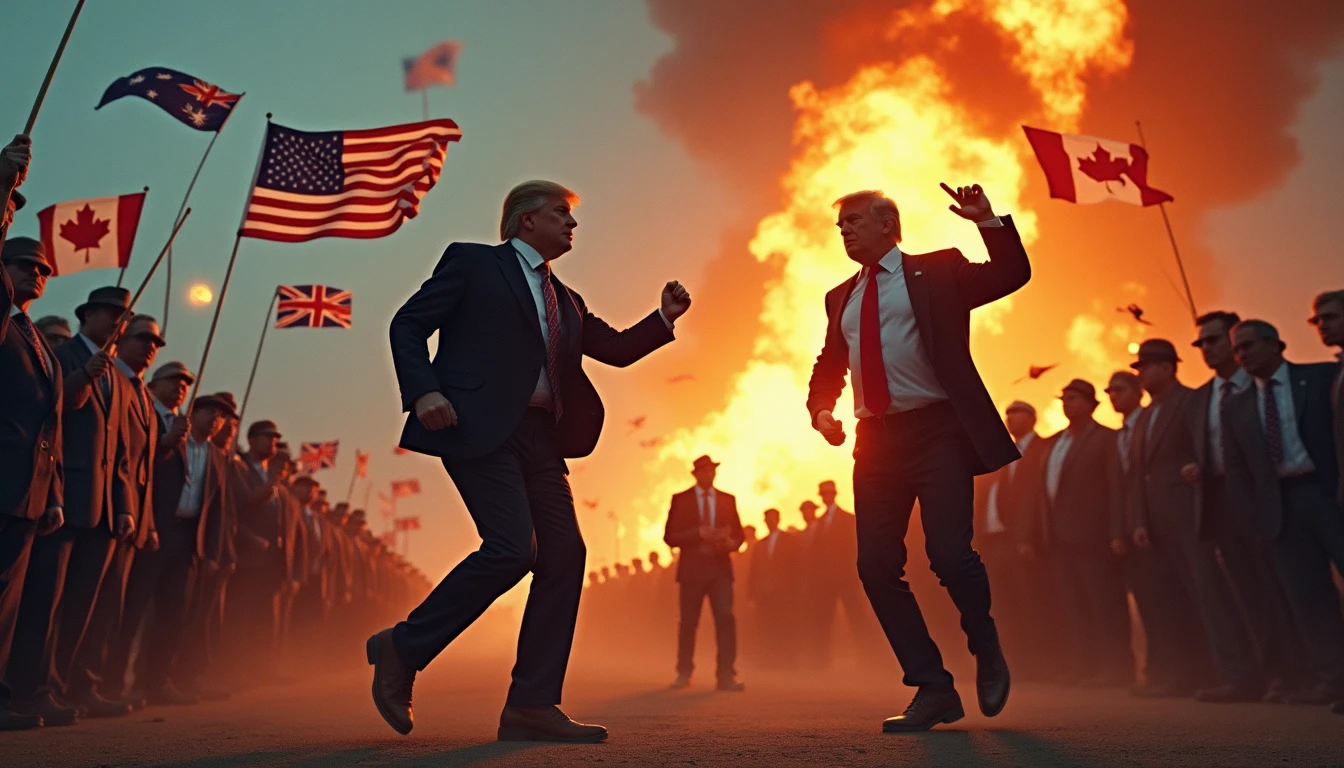
"Master Race" Claim Reviving 19th-Century Anglo-Saxonism Surfaces in US Political Debate
Multi-perspective analysis. Each perspective deliberately argues one viewpoint; none represents the editorial position of qalarc.
An assertion that English-speaking peoples of Anglo-Saxon descent — the settler stock of the British Empire's former colonies in what became the United States, Canada and Australia — constitute a 'master race' is at the center of a sharply polarized online political debate in the US. The claim revives Anglo-Saxonism, a 19th-century racial-imperial doctrine used to justify British and American expansion [6], and borrows the 'master race' concept most identified with Nazi racial ideology [7]. It is being argued as Donald Trump's second presidency, tariff conflict with Canada and the 2026 Iran war — closed by a June 15, 2026 deal to reopen the Strait of Hormuz [3] — fuel arguments over America's trajectory.
The facts (8)
- The claim's substance: that the British Empire's dominion over the territory of the modern United States, Canada and Australia — an empire its backers measure against Rome's — demonstrates the innate supremacy of 'Anglo' peoples over other groups, including Italians and other Europeans. The 'master race' (Herrenvolk) formulation it relies on is the core construct of Nazi racial theory, which claimed a Germanic-Aryan right to rule and was repudiated after 1945 [7].
- The claim's direct ancestor is Anglo-Saxonism: the 19th-century doctrine that the Germanic peoples who settled post-Roman Britain from the fifth century onward [5] produced a uniquely capable 'race' destined to expand, an idea invoked to legitimize both British imperial rule and American continental expansion before collapsing into academic and legal disrepute [6].
- The immediate political backdrop is Donald Trump's second presidency, inaugurated January 20, 2025, which has combined sweeping tariffs on Canadian goods with Trump's repeated public suggestions that Canada should accede to the United States as its 51st state [2].
- Potash, a potassium salt essential to fertilizer, became a specific flashpoint in that dispute: Canada is the world's largest potash producer and exporter, centered on Saskatchewan, and US agriculture depends heavily on Canadian supply [4].
- The geopolitical backdrop is the 2026 war between the United States and Iran [1], which disrupted the Strait of Hormuz; on June 15, 2026, NPR reported Washington and Tehran had reached an initial deal to end the war and reopen the strait [3].
- Within the same debate, participants asserted that large-scale war reaching US soil is 'inevitable,' framed as 'fascists versus communists,' with the US itself cast as 'the enemy of humanity.' Nothing in the verifiable record supports the framing: the 2026 conflict was fought in the Middle East and was closed through negotiation rather than escalation onto American territory [3].
- A parallel strand of the debate concerns emigration: participants argued Canada's practical appeal to Americans amounts to universal single-payer healthcare, cannabis legal at the federal level since October 2018, friendly communities and escape from US student-loan debt — while others mocked the American phrase 'Land of the Free,' and one participant wrote that Trump's conduct had converted them to the political left. These are personal assertions without cited evidence, though the underlying policy contrasts (healthcare, cannabis law, debt levels) are accurate.
- The most-engaged reply in the exchange ridiculed Italians for racism toward Black people 'meanwhile they look this,' an implicit rebuttal showing the racial hierarchy turning on its own adherents — Italians being heirs of Rome, the very empire invoked as the benchmark of civilizational greatness alongside the British Empire.
Context & background
Anglo-Saxonism arose at the height of British imperial power in the 1800s, holding that the Anglo-Saxon peoples who settled England after Rome's withdrawal [5] formed a superior 'Teutonic' stock destined to rule — a doctrine that fused with Social Darwinism and was invoked for both the British Empire's global expansion and American manifest destiny [6]. Its cognate claim of a Germanic 'master race' culminated in Nazi ideology, and the entire framework of racial hierarchy was repudiated by postwar scholarship [7]; Anglo-Saxonist language now survives mainly in far-right fringe rhetoric, including the slurs, praise of Hitler ('the Führer already knew that') and anti-suffrage arguments that appeared in reply traffic around this claim. The current setting is unusually charged. Trump's second term has paired tariffs on Canadian imports — including the fertilizer input potash, dominated by Canadian production [4] — with annexation talk aimed at Ottawa [2], while the 2026 Iran war and its negotiated end via the Hormuz deal [1][3] added geopolitical anxiety. US interest in moving to Canada has historically spiked during Trump-era political shocks, most notably when Canada's official immigration website crashed on US election night in November 2016, and the current debate repeats that pattern.
Still unresolved
- Who is actually advancing the 'Anglo master race' claim — and whether it reflects sincere ideological belief or deliberate provocation — cannot be established from the unattributed discussion in which it surfaced.
- No mainstream analyst forecast or strategic assessment has been identified that supports the assertion that large-scale war on US soil is 'inevitable'; whether any serious analyst holds this view remains unknown.
- The extent to which the racist, antisemitic and pro-Hitler sentiment in the replies reflects broader public opinion, rather than a self-selected fringe, would require polling or hate-crime tracking data that has not been cited.
Quick answers
What happened?
An assertion that English-speaking peoples of Anglo-Saxon descent — the settler stock of the British Empire's former colonies in what became the United States, Canada and Australia — constitute a 'master race' is at the center of a sharply polarized online political debate in the US.
What's the evidence?
Checked against 14 candidate sources; the strongest references include: 2026 Iran war — Wikipedia; Second presidency of Donald Trump — Wikipedia; U.S. and Iran reach initial deal to end war, reopen Strait of Hormuz — NPR, June 15, 2026.
Who benefits?
Nutrien and Saskatchewan potash producers (incl. Mosaic's Canadian operations) — Scarcity rent plus proof of indispensability in any future negotiation. Russia (Uralkali) and Belarus (Belaruskali) — Market share recovery and de facto sanctions relief. China — Five Eyes fragmentation plus discounted inputs
How confident is the assessment?
The motive analysis is 62% confident.
Why does it matter?
Tariff threats on Canadian potash -> US fertilizer costs jump against inelastic global supply -> corn/soy input floor rises -> food CPI -> farm-state political backlash -> carve-outs granted -> adversaries catalog America's commodity pressure points (potash, uranium, softwood lumber) and price them into future…
The same story, argued three ways. Pick an angle — the facts above stay the same.
🧭 Cui bono — who benefits?
Beneficiaries
- Nutrien and Saskatchewan potash producers (incl. Mosaic's Canadian operations) — Scarcity rent plus proof of indispensability in any future negotiation
via Canada holds roughly a third of world potash capacity and supplies ~90% of US imports; tariff threats put a fear premium into global benchmark prices while Washington's subsequent carve-outs confirm US agriculture cannot substitute away. That hostage value can now be priced into every future US-Canada negotiation. - Russia (Uralkali) and Belarus (Belaruskali) — Market share recovery and de facto sanctions relief
via US-Canada fertilizer friction pushes Washington toward quietly tolerating sanctioned Belarusian and Russian potash via intermediaries, as occurred in 2022-23 when Treasury general licenses loosened flows under food-price pressure, restoring revenue to two regimes underwriting the war in Ukraine. - China — Five Eyes fragmentation plus discounted inputs
via US-Canada hostility degrades NORAD and intelligence-sharing at zero cost to Beijing, while China buys Canadian potash, wheat and crude that Ottawa is newly motivated to diversify. The paired circulation of 'Anglosphere supremacy' and 'US as enemy of humanity' narratives serves Chinese strategic ends without requiring any Chinese fingerprints. - Canada's Liberal government and domestic-first retailers — Rally-round-the-flag incumbency and boycott-driven market share
via '51st state' rhetoric drove Canadian favorability toward the US to record lows (Pew 2025) and fueled the nationalist surge behind the 2025 Liberal re-election; consumer boycotts of US alcohol and brands route that spend to domestic producers and retailers like Loblaw. - Engagement-optimized platforms and partisan media on both flanks — Attention inventory and advertising revenue
via 'Trump made me a leftist' conversion arcs and 'US = enemy of humanity' maximalism are algorithmically optimal escalation content; right-populist US outlets and anti-US Anglophone media monetize the same outrage spiral from opposite directions.
Who loses
- US row-crop farmers, who import ~90% of their potash from Canada and absorb tariff-inflated fertilizer costs that floor up corn and soy margins and leak into food CPI
- NORAD and Five Eyes cohesion, since treating Canada as an adversary degrades the continental defense and intelligence architecture the US itself depends on
- US consumer brands in Canada, hit by coordinated boycotts of alcohol, produce and retail chains in a top-three export market
- Indebted young Americans sold the 'Canada escape hatch', where the debt-and-healthcare refuge narrative collides with credential recognition and waitlists: the sentiment is real, the exit mostly is not
Ramifications (follow the chain)
- Tariff threats on Canadian potash -> US fertilizer costs jump against inelastic global supply -> corn/soy input floor rises -> food CPI -> farm-state political backlash -> carve-outs granted -> adversaries catalog America's commodity pressure points (potash, uranium, softwood lumber) and price them into future confrontations
- Humiliation-as-leverage diplomacy -> record anti-US sentiment in Canada plus consumer boycotts -> Liberals re-elected on resisting Washington -> durable Canadian diversification of energy, potash and lumber toward Asia and the EU -> the US permanently loses captive-supplier pricing on its own continent
- 'Anglo master-race / new Rome' identity content on one flank, 'US = enemy of humanity' on the other -> mutual radicalization inside the Anglosphere -> the UK and Australia are forced to arbitrate between Washington and Ottawa -> trust deficit degrades intelligence-sharing and joint procurement -> Russia and China obtain alliance fragmentation they could never compel militarily
- Anti-US political conversion plus the Canada-as-refuge narrative among young Anglophones -> soft pressure for skilled US emigration to Toronto, Vancouver and Montreal -> talent flow strengthens exactly the Canadian industries Washington is threatening -> antagonism subsidizes the competitor
intentional reading Label: the Wedge-and-Leverage hypothesis. The primary intentional beneficiary is Moscow: the simultaneous circulation of Anglo-supremacist 'new Rome' framing and anti-American 'enemy of humanity' rhetoric is the classic dual-edge wedge documented in Russian influence operations since 2016, and reporting on bot amplification of US-Canada annexation talk fits the pattern. The racial-civilizational framing matters specifically because it defines the alliance by sentiment rather than treaty, making it breakable by sentiment. Secondary intentional actor: Trump's own negotiators, for whom public humiliation and tariff threats are deliberate extractive tactics, with alliance corrosion accepted as collateral. No evidence the individual online voices are directed; they are farmed, not commanded.
structural reading No conspiracy required. Trump's personal bargaining style mechanically manufactures anti-American sentiment abroad; Canadian incumbents mechanically profit from defying it; engagement algorithms mechanically promote both the supremacism and the reaction because each is maximal-outrage content; and potash is simply geology: Saskatchewan holds the deposits, so any US-Canada rupture automatically transfers rents to producers and sanctioned rivals while US farmers pay the bill. Aligned incentives, zero coordination, identical outcome.
From the threads
The posts that drew the most replies in the source discussion — shown as posted. Reactions ranged across the spectrum; these are the ones people actually engaged with.
italians racist to n****** meanwhile they look this
The people are friendly and weed is legal and they have single payer healthcare, but that's about it.
Continue the discussion
Add your own take — replies are kept on this article and can be upvoted.
🔗 Related Analysis
- Trump to rename Lake Ontario to 'Lake America' shared: canada, donald trump, united states
- Criticism of Indian diaspora presence and inaction by citizens shared: british empire, canada, united states
- Obesity rates USA vs Japan demographic comparison shared: canada, united states
- Trump declares Canada the most difficult country he has dealt with shared: canada, donald trump
- Conspiracy theory of USA, Israel, and Morocco orchestrating a border breach in Spain shared: donald trump, united states
- Prediction of U.S. ground war quagmire in Iran shared: donald trump, united states
Discussion
Select any text in the article to comment on that passage.